ESP32-C3 vs C6 vs S3: Specs, Differences and Which to Pick
ESP32-C3 vs C6 vs S3: quick spec comparison
If you just want the short answer: the three chips split cleanly into a budget Wi-Fi/BLE part (C3), a modern-radio part (C6) and a high-performance part (S3). The table below only lists what Espressif's own ESP-IDF getting-started documentation states for each target, so there are no guessed clock speeds, memory sizes or prices here.
| Feature | ESP32-C3 | ESP32-C6 | ESP32-S3 |
|---|---|---|---|
| CPU | 32-bit RISC-V, single core | 32-bit RISC-V, single core | Dual Xtensa 32-bit LX7 cores |
| Low-power co-processor | Not listed | Not listed | ULP running RISC-V or FSM |
| Wi-Fi | 2.4 GHz | Wi-Fi 6, 2.4 GHz | 2.4 GHz |
| Bluetooth | Bluetooth LE | Bluetooth LE | Bluetooth LE |
| 802.15.4 (Thread/Zigbee) | No | Yes | No |
| USB OTG | Not listed | Not listed | Yes |
| USB Serial/JTAG controller | Not listed | Not listed | Yes |
| Built-in security hardware | Yes | Yes | Yes |
| Process | 40 nm | 40 nm | 40 nm |
| Official dev kits | C3-DevKitM-1, C3-DevKitC-02, C3-LCDkit | (see Espressif dev-kit docs) | S3-DevKitC-1, S3-DevKitM-1, S3-USB-OTG, S3-LCD-EV-Board, ESP-VoCat |
Two things stand out immediately. First, the S3 is the only one of the three with two application cores and a dedicated ULP co-processor. Second, the C6 is the only one with Wi-Fi 6 and an IEEE 802.15.4 radio for Thread and Zigbee. The C3 has neither of those extras, which is exactly why it tends to be the simplest and cheapest board in the lineup, though the sources here do not quote prices.
The rest of this guide unpacks those rows and explains when each difference actually matters in a real build.
 \2
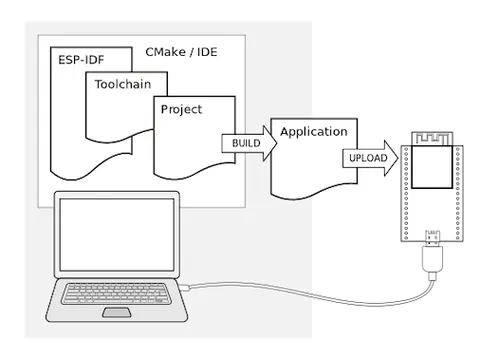
ESP-IDF getting-started workflow, which is the same for ESP32-C3, C6 and S3 targets.
What is the CPU difference between the C3, C6 and S3?
This is the biggest architectural split. The ESP32-C3 and ESP32-C6 both use a single high-performance 32-bit RISC-V core. The ESP32-S3 uses two Xtensa 32-bit LX7 cores, which is the same CPU family found in the original ESP32 (LX6) and the ESP32-S2 (single LX7).
Why does this matter in practice?
- Parallel workloads. With two cores, the S3 can keep the Wi-Fi and Bluetooth stacks busy on one core while your application, a display refresh loop or an audio pipeline runs on the other. On the single-core C3 and C6, everything shares one core and relies on the RTOS scheduler to interleave tasks.
- Low-power background work. Only the S3 lists an Ultra Low Power co-processor, which can run either as a small RISC-V core or as a finite-state machine. That lets simple sensor polling continue while the main cores sleep. The C3 and C6 summaries do not mention a ULP block.
- Toolchain. RISC-V versus Xtensa is mostly invisible if you use ESP-IDF, Arduino or MicroPython, because the build system picks the right compiler for the selected target. It can matter if you rely on third-party native libraries or hand-written assembly.
For most hobby projects such as reading a sensor and publishing over MQTT, driving a few LEDs or hosting a tiny web page, a single RISC-V core is plenty. The dual-core S3 becomes worth it when you are pushing pixels to a TFT, decoding audio, or running inference on microphone or camera data.
Espressif notes that all three chips are built on 40 nm technology, so the process node itself is not a differentiator; the core count and co-processor are.
Which chip has the best wireless: Wi-Fi 6, BLE and Zigbee?
All three chips share the basics: 2.4 GHz Wi-Fi and Bluetooth Low Energy. None of them offer Bluetooth Classic, so if you need A2DP audio streaming to a classic headset, these are not the right parts.
The ESP32-C6 pulls ahead in two ways:
- Wi-Fi 6 (802.11ax) on 2.4 GHz. The C3 and S3 are limited to older 2.4 GHz Wi-Fi. For a battery sensor that wakes, transmits a few bytes and sleeps, Wi-Fi 6 scheduling features can be a real advantage on a router that supports them. If you need 5 GHz, note that Espressif's dual-band part is the ESP32-C5, not any of the three compared here.
- 802.15.4 radio for Thread and Zigbee. This is the headline feature. A C6 can act as a Zigbee end device or router, or as a Thread device for Matter-style networks, without a separate radio module. Neither the C3 nor the S3 have this radio.
For the common search framing of "esp32 c6 vs c3 vs s3", the wireless row usually settles the decision:
| Need | Pick |
|---|---|
| Plain Wi-Fi + BLE, nothing exotic | C3 (or S3 if you need the CPU) |
| Zigbee or Thread device | C6 |
| Wi-Fi 6 on 2.4 GHz | C6 |
| Bluetooth Classic | None of these three |
One more connectivity note from the ESP-IDF docs: the ESP32-P4 has no built-in radio and Espressif suggests pairing it with an external wireless SoC such as the ESP32-C6. That hints at the C6's intended role as a connectivity-first chip.
USB, peripherals and security: what else differs?
USB. The ESP32-S3 feature list includes both a USB OTG interface and a USB Serial/JTAG controller. USB OTG lets the S3 act as a USB device (keyboard, mass storage, custom HID) or host, and Espressif even sells a dedicated ESP32-S3-USB-OTG board for that purpose. The built-in USB Serial/JTAG controller means you can flash and debug through a plain USB cable without an external bridge chip. The C3 and C6 summaries in the getting-started documentation do not list USB OTG, so if a USB device role is central to your project the S3 is the safe choice.
Peripherals. All three are described as having "multiple peripherals": SPI, I2C, UART, PWM and so on. The ESP-IDF SPI Master driver, for example, is the same API across targets, supporting DMA transfers, multiple devices on one bus, and both interrupt and polling transactions. Day-to-day peripheral code tends to port between the three with little change beyond pin assignments. The sources do not give per-chip GPIO counts, so check the datasheet for your exact module before committing to a design with many pins.
Security hardware. All three list built-in security hardware (secure boot, flash encryption and crypto accelerators are the usual contents of that bullet). For a commercial or exposed device, none of the three leaves you without hardware security.
Display and GUI work. The S3 ecosystem is clearly geared toward screens: Espressif offers an ESP32-S3-LCD-EV-Board, and the C3 has a C3-LCDkit. The XIAO PowerBread project is a nice data point here: its v3.0 firmware runs LVGL 8.3 with LovyanGFX on a 0.96" ST7735 LCD, with FreeRTOS tasks for sampling, UI, input and serial streaming, and it supports XIAO ESP32-S3, ESP32-C3 and ESP32-C6 boards alike. A small SPI display is therefore achievable on any of the three; the S3 simply has more headroom for larger or faster panels.
Which ESP32 should I choose for my project?
Here is a practical mapping of common maker projects to the best fit among the three chips, based purely on the feature differences above.
| Project type | Best fit | Why |
|---|---|---|
| Wi-Fi sensor node, MQTT publisher, smart plug | ESP32-C3 | Wi-Fi + BLE and security hardware are all you need; single RISC-V core is sufficient |
| Zigbee sensor, Zigbee router/range extender, Thread device | ESP32-C6 | Only chip of the three with 802.15.4 |
| Future-proof Wi-Fi device on a Wi-Fi 6 network | ESP32-C6 | Wi-Fi 6 on 2.4 GHz |
| Voice assistant, I2S audio, microphone processing | ESP32-S3 | Dual LX7 cores keep audio and networking separate |
| TFT dashboard with LVGL, touch UI | ESP32-S3 (C3/C6 for small panels) | More CPU headroom; S3-LCD-EV-Board exists for this |
| USB keyboard, HID, mass-storage or USB host gadget | ESP32-S3 | Only chip listed with USB OTG |
| Battery device needing background sensing while asleep | ESP32-S3 | Only chip listed with a ULP co-processor |
| BLE beacon or BLE scanner | Any; C3 is the leanest | All three have Bluetooth LE |
| Breadboard tool or small gadget on a XIAO board | Any | XIAO versions of all three run the same PowerBread firmware |
A few rules of thumb:
- Start with the radio requirement. If Zigbee or Thread appears anywhere in the plan, you are buying a C6 and the decision is made.
- Then ask about USB and CPU load. USB device roles, audio or camera-class work push you to the S3.
- Default to the C3 otherwise. For the long tail of Wi-Fi/BLE projects, the C3 does the job with fewer features to pay for.
If you are torn between the C6 and the S3 specifically, our dedicated ESP32-C6 vs S3 guide goes deeper on that pairing.
Do the C3, C6 and S3 use the same development workflow?
Yes. Espressif's ESP-IDF getting-started guide is written once and rendered per target, and the hardware list is identical for all three: an ESP32-family board, a USB cable and a computer running Windows, Linux or macOS. The workflow of installing the toolchain, configuring the project with the menu system, then building and flashing is the same regardless of whether you selected the C3, C6 or S3 target.
Things to watch for when switching between the three:
- Connector type. Espressif warns that some newer development boards ship with USB Type-C connectors instead of micro USB, so make sure you have the right cable.
- Target selection. When you change chips you must re-select the target in your build system so the correct compiler (RISC-V for C3/C6, Xtensa for S3) and peripheral drivers are used.
- Official boards. For the C3, Espressif lists the C3-DevKitM-1, C3-DevKitC-02 and C3-LCDkit. For the S3, the DevKitC-1, DevKitM-1, USB-OTG, LCD-EV-Board and ESP-VoCat. These are good references if you want known-good hardware before designing your own.
Third-party ecosystems follow the same pattern. The XIAO PowerBread project ships a single v3.0 firmware for the XIAO ESP32-S3, ESP32-C3 and ESP32-C6, with FreeRTOS tasks and LVGL running on all three. That is a useful real-world confirmation that code written for one of these chips usually moves to the others with modest effort, as long as you are not depending on S3-only hardware like USB OTG or the ULP, or C6-only hardware like the 802.15.4 radio.
In short, pick the chip for its radio and compute features, not for toolchain convenience. The software side is largely the same across esp32 s3 vs c3 vs c6.
Frequently asked questions
Is the ESP32-C6 better than the ESP32-C3?
For connectivity, yes: the C6 adds Wi-Fi 6 on 2.4 GHz and an 802.15.4 radio for Thread/Zigbee. Both use a single 32-bit RISC-V core, Bluetooth LE and built-in security hardware.
Does the ESP32-S3 have Zigbee?
No. Of the three, only the ESP32-C6 lists 802.15.4 Thread/Zigbee support. The S3 offers 2.4 GHz Wi-Fi and Bluetooth LE.
Which ESP32 has USB OTG?
The ESP32-S3 lists a USB OTG interface and a USB Serial/JTAG controller. The C3 and C6 feature summaries do not include USB OTG.
Do any of these chips support 5 GHz Wi-Fi?
No. The C3 and S3 are 2.4 GHz Wi-Fi, and the C6 is Wi-Fi 6 on 2.4 GHz only. Espressif's dual-band 2.4/5 GHz part is the ESP32-C5.
Can I run the same firmware on XIAO C3, C6 and S3 boards?
Often, yes. The XIAO PowerBread v3.0 firmware with FreeRTOS and LVGL 8.3 supports XIAO ESP32-S3, ESP32-C3 and ESP32-C6 from one codebase.
Choose the ESP32-C6 whenever Zigbee, Thread or Wi-Fi 6 is on the table; it is the only one of the three with those radios. Choose the ESP32-S3 for display, audio, USB-device or heavier compute projects thanks to its dual LX7 cores, ULP co-processor and USB OTG. For everything else, the single-core ESP32-C3 covers Wi-Fi and BLE with the least complexity.
Sources
github.comGet Started (esp-idf docs)github.comSPI Master Driver (esp-idf docs)github.comnicho810/XIAO-PowerBread (GitHub README)This guide summarises the public sources listed above in our own words. Check the original documentation before relying on exact figures.