ESP32 vs ESP32-S2: Key Differences and Which to Choose
What are the ESP32 and ESP32-S2?
Both chips come from Espressif and sit at the heart of the maker and IoT ecosystem. The original ESP32 has been a community staple for years. The ESP32-S2 is the first chip in Espressif's S-series redesign — it centres on a single Xtensa core, drops Bluetooth entirely, and gains native USB OTG plus a noticeably larger set of GPIOs and analogue peripherals.
Both are first-class targets in the ESP-IDF build system and the Arduino-ESP32 framework. If you run idf_parametrize in a pytest script, you can target either chip simply by passing 'esp32' or 'esp32s2' — both are listed as supported targets.
 \2
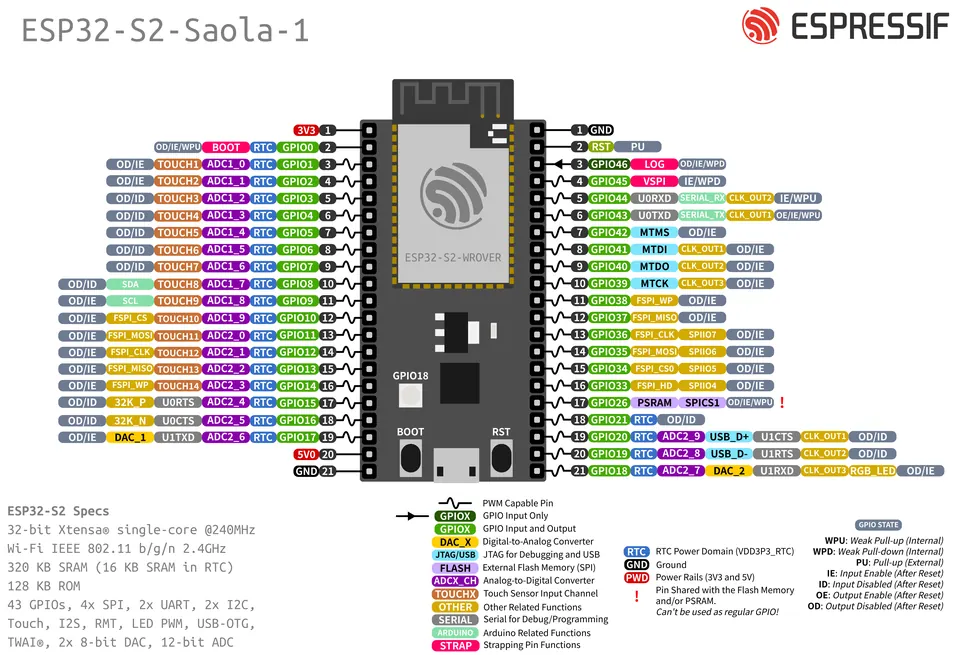
Strapping pin table for the ESP32-S2, showing GPIO0, GPIO45, and GPIO46 boot-mode defaults on the Saola-1 board.
Key specs compared: what the documentation confirms
The table below is drawn directly from the ESP32-S2-Saola-1 official documentation. The ESP32-S2-Saola-1 is Espressif's reference development board for the chip, based on the ESP32-S2-WROVER module with 4 MB integrated SPI flash and 2 MB of PSRAM on board.
| Feature | ESP32-S2 (source-confirmed) |
|---|---|
| CPU | Single-core Xtensa |
| Bluetooth | Not present |
| Wi-Fi | 802.11b/g/n, up to 150 Mbps |
| Programmable GPIOs | 43 |
| ADC | 2× 13-bit SAR, up to 20 channels |
| DAC | 2× 8-bit |
| Touch-sensing IOs | 14 |
| SPI buses | 4 |
| I2C buses | 2 |
| UART | 2 |
| I2S | 1 |
| USB OTG | Full-speed |
| Camera interface | DVP 8/16 (via I2S hardware) |
| LCD interface | 8-bit serial RGB/8080/6800 (via SPI2); 8/16/24-bit parallel (via I2S) |
| TWAI (CAN-compatible) | Yes, ISO 11898-1 compatible |
| Temperature sensor | Built-in |
| LED PWM channels | Up to 8 |
The ESP32-S2 sources do not list Bluetooth support — this absence is a deliberate design choice, not a documentation gap.
Does the single core matter for your project?
The ESP32-S2 runs one Xtensa core. This is the sharpest architectural break from the original ESP32. For projects that run a single foreground task — controlling a display, reading sensors, acting as a USB HID device — one core is usually plenty, and the simpler scheduling can make firmware easier to reason about.
Where a single core becomes a constraint is when you need to simultaneously run a real-time loop, handle Wi-Fi networking, and process data-intensive tasks. Dual-core chips let you pin tasks to separate cores to avoid latency spikes; the ESP32-S2 cannot do that. If your design needs sustained parallel workloads, the original ESP32 family (or the later S3, which returns to dual-core) is a safer choice.
For ESP-IDF testing, both chips are treated as equivalent parameterised targets, so existing test coverage generally ports without rewrites.
What does native USB OTG change in practice?
The ESP32-S2 includes a full-speed USB OTG controller wired directly to GPIO19 (USB D−) and GPIO20 (USB D+). This means the chip can appear to a host computer as a USB device — a serial port, HID keyboard or mouse, mass-storage device, or custom class — without any external USB-to-UART bridge chip.
For the developer, this has a concrete benefit during prototyping: you can flash and monitor the board over the same USB cable without a separate FTDI or CP2102 converter. For end products, it opens the door to building custom USB peripherals, composite devices, or firmware-upgrade flows that use native USB DFU.
The original ESP32 does not have this hardware block. Getting USB device behaviour out of an original ESP32 requires an external bridge chip and is limited to serial communication.
Note that GPIO19 and GPIO20 serve double duty on the Saola-1 — they carry ADC2 channels and DAC_2 in addition to USB signals — so plan pin assignments carefully if you are mixing USB and analogue inputs.
GPIO, analogue, and touch: where the ESP32-S2 expands your options
With 43 programmable GPIOs the ESP32-S2 gives you more pins to work with, which is useful in control panels, matrix keyboards, or display drivers that consume many lines at once.
The analogue section includes two 13-bit SAR ADCs spread across up to 20 channels. The DAC provides two independent 8-bit channels on GPIO17 and GPIO18. Fourteen of the GPIOs double as capacitive touch inputs, which is enough to build a reasonably complex touch interface without external touch controllers.
There is one pin to watch: GPIO26 is wired internally to PSRAM on the WROVER module and cannot be used for general I/O on that variant. GPIO46 is input-only and cannot be driven as an output. Keep these restrictions in mind when assigning peripherals.
Strapping pins also matter at boot. GPIO0 defaults to pull-up (SPI boot), GPIO45 controls the internal LDO voltage, and GPIO46 has a dual role: it selects boot mode and controls whether log output is active during startup. Pulling GPIO46 low during power-on suppresses UART log output.
Camera and display support on the ESP32-S2
The ESP32-S2 exposes a DVP camera interface (8-bit or 16-bit parallel) implemented through its I2S hardware resources. This lets you connect standard OV-series camera modules without external frame grabbers.
On the display side there are two paths: an 8-bit serial RGB/8080/6800 interface routed through SPI2, and an 8/16/24-bit parallel interface via I2S. Both sit inside the chip rather than requiring SPI-only bit-banging, which is useful when building local display-heavy applications.
This combination — camera in, display out, USB OTG — makes the ESP32-S2 an attractive foundation for projects that process or relay visual data over USB, or that need a self-contained panel interface without extra silicon.
Which chip should you choose?
Use this decision framework based on what the sources confirm about the ESP32-S2:
| Your need | Better choice |
|---|---|
| Bluetooth Classic or BLE | Original ESP32 |
| Dual-core parallel workloads | Original ESP32 |
| Native USB device (HID, CDC, DFU) | ESP32-S2 |
| High GPIO count (43 pins) | ESP32-S2 |
| Built-in DVP camera interface | ESP32-S2 |
| Capacitive touch (14 channels) | ESP32-S2 |
| CAN bus (TWAI / ISO 11898-1) | ESP32-S2 |
| Parallel LCD interface | ESP32-S2 |
| Simple Wi-Fi IoT node, existing code | Either, depending on library support |
Both chips are supported by ESP-IDF and Arduino-ESP32, so framework choice alone should not determine which you pick. Focus on the hardware peripherals your design requires. If the project needs Bluetooth, the ESP32-S2 is a dead end. If it needs USB device mode or a camera interface, the ESP32-S2 is the cleaner path.
Frequently asked questions
Does the ESP32-S2 have Bluetooth?
No. The ESP32-S2 documentation lists Wi-Fi (802.11b/g/n) but does not include Bluetooth support. This is a fundamental hardware difference from the original ESP32.
How many GPIOs does the ESP32-S2 have?
The ESP32-S2 provides 43 programmable GPIOs, though not all are exposed on every development board header. GPIO26 is reserved for PSRAM on the WROVER module and GPIO46 is input-only.
Can the ESP32-S2 act as a USB device without extra hardware?
Yes. The ESP32-S2 includes a full-speed USB OTG controller connected directly to GPIO19 (D−) and GPIO20 (D+), so no external USB-to-UART bridge is required for USB device mode.
Are both chips supported in ESP-IDF?
Yes. ESP-IDF explicitly lists both 'esp32' and 'esp32s2' as supported build and test targets. You can parameterise a single test script to run on both without rewriting it.
Does the ESP32-S2 support a camera interface?
Yes. The ESP32-S2 includes a DVP 8/16-bit parallel camera interface implemented through the I2S hardware resources, suitable for connecting standard camera modules directly.
The ESP32-S2 is a focused redesign that trades Bluetooth and the second CPU core for native USB OTG, a larger GPIO count, a camera interface, and dedicated LCD paths. It is the right pick when your project is Wi-Fi plus USB or Wi-Fi plus camera with no Bluetooth requirement. Stick with the original ESP32 when you need Bluetooth or when existing dual-core firmware makes the migration cost too high.
Sources
github.comESP32-S2-Saola-1 (arduino-esp32 docs)github.comESP-IDF Tests with Pytest Guide (esp-idf docs)This guide summarises the public sources listed above in our own words. Check the original documentation before relying on exact figures.